If you’ve ever wondered just what a charter school is or how it might or might not work for your family, be sure to hop on over and read my article about charter schools at Latter-day Homeschooling. Feel free to leave a comment with any questions I might not have answered in my post or experiences you’ve had with charter schools.
Showing posts with label how to. Show all posts
Showing posts with label how to. Show all posts
Monday, April 23, 2012

Monday, April 4, 2011
How Memory Time Works For Us
First, what is memory work? Memory work, in our school, is a specific time set aside to work on memorizing facts. By memorizing, I mean being able to recite back exact word for word a fact, poem, quote, or scripture.
Okay, you might think, But Why? "Houses rest on foundations." This simple sentence written by Jessie Wise and Susan Wise Bauer in The Well-Trained Mind has struck with me for the last ten years. With a foundation of knowledge (those memorized facts), a student will find it much easier to move on to higher learning, to think critically, and then to be able express themselves in an ordered logical manner. Have you experienced a student having a hard time with long division or algebraic equations because they don't have their multiplication facts memorized? Have you engaged in a conversation with someone who has vague ideas about how things work, but can't quite put into words the why or how? Memorization provides the foundation.
I consider memory time a subject unto its self, but in reality memory time brings together all the subjects we study. We use memory time to cement facts from math, science,, grammar, literature, geography, history, religion, language, and common knowledge.
Each week, my kids and I pick memory work. We try to balance what we are working on across our whole curriculum. I posted a few resources we are using, but in reality for the most part what we memorize comes from our other curriculum. Last week we memorized what an appositive adjective is and how it is used. This rule came directly from our English curriculum. It was a new concept that needed to be memorized, so instead of slowing down in English to learn it I added it to memory time. I do the same with memorizing dates in history. My kids take turns picking the poetry we work on memorizing. I use to type up what we were memorizing for the kids to have in their binders, but I've recently decided that it helps with the memory process for the kids to write out the work themselves. Also when copying poetry, I have them work on their penmanship.
The tools for memory time are pretty simple. Everyone has a binder.

 And we used simple file folders to make 31 dividers for each binder. So each binder has 31 dividers marked with a 1 through 31. In addition, each divider is also marked with a day of the week. So the first divider is marked with a 1 and a M (for Monday), the second is marked with a 2 and a T (for Tuesday) all the way through the 5th divider being marked with a 5 and F (for Friday).


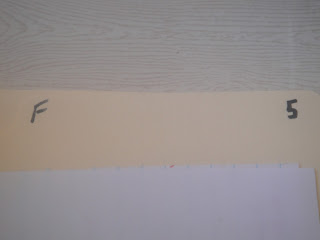
Then we start over with labeling the days of the weeks. The number six divider gets labeled with a M (for Monday),

the number seven divider is labeled with a T (for Tuesday),

and so forth through all thirty-one dividers. I decide on the things to memorize for the week and type them up so I have a copy of things to look at throughout the week. Then on Monday the kids copy them. Of course, we don't memorize things on a perfectly weekly basis, so in reality things get copied throughout the week as other things are memorized. The things that are currently being memorized are filed at the very beginning of the binder.
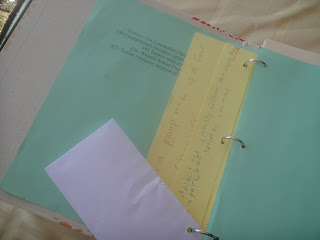 Here are some history dates and two science facts. The envelope has a copy of the history dates cut up into a puzzle. My daughter was having a hard time with the dates, so we did this to give her a little bit more practice working with them. After fully memorizing the facts, we file them behind the divider of the day they were memorized on.

Glancing at this fact sheet I can see it was fully memorized on the 6th of some month. The month doesn't really matter. The dates and days of the week on the dividers are used for reviewing. Every day we look at what is behind the date divider of that day and review it. We also look at what is behind today's days. So every Monday we review what is behind all the Mondays; every Tuesday we review what is behind all the Tuesday tabs, and so forth and so on.
Over the years I've found memory time has to happen first or it doesn't happen at all. We start out copying any thing that needs copying. Then we move onto reading it through three times. Often times that is all we do for the first few days of memorizing a piece. After that we quiz each other on the piece. For some things I try to have resources that set facts to music, or we use games to make the memorization a bit more fun. In order to file the piece away in their binder, the kids have to be able to say it three times without a mistake. In my mind, memory time takes a nice short 20-30 minutes, but in reality it really takes a good 45-60 minutes depending on what the kids need to copy and how long the pieces are they are working on.
I hope this answered any questions about the why and how of memory time. Can't wait to read how and what memory time is in your school this week.
Okay, you might think, But Why? "Houses rest on foundations." This simple sentence written by Jessie Wise and Susan Wise Bauer in The Well-Trained Mind has struck with me for the last ten years. With a foundation of knowledge (those memorized facts), a student will find it much easier to move on to higher learning, to think critically, and then to be able express themselves in an ordered logical manner. Have you experienced a student having a hard time with long division or algebraic equations because they don't have their multiplication facts memorized? Have you engaged in a conversation with someone who has vague ideas about how things work, but can't quite put into words the why or how? Memorization provides the foundation.
I consider memory time a subject unto its self, but in reality memory time brings together all the subjects we study. We use memory time to cement facts from math, science,, grammar, literature, geography, history, religion, language, and common knowledge.
Each week, my kids and I pick memory work. We try to balance what we are working on across our whole curriculum. I posted a few resources we are using, but in reality for the most part what we memorize comes from our other curriculum. Last week we memorized what an appositive adjective is and how it is used. This rule came directly from our English curriculum. It was a new concept that needed to be memorized, so instead of slowing down in English to learn it I added it to memory time. I do the same with memorizing dates in history. My kids take turns picking the poetry we work on memorizing. I use to type up what we were memorizing for the kids to have in their binders, but I've recently decided that it helps with the memory process for the kids to write out the work themselves. Also when copying poetry, I have them work on their penmanship.
The tools for memory time are pretty simple. Everyone has a binder.


Then we start over with labeling the days of the weeks. The number six divider gets labeled with a M (for Monday),

the number seven divider is labeled with a T (for Tuesday),

and so forth through all thirty-one dividers. I decide on the things to memorize for the week and type them up so I have a copy of things to look at throughout the week. Then on Monday the kids copy them. Of course, we don't memorize things on a perfectly weekly basis, so in reality things get copied throughout the week as other things are memorized. The things that are currently being memorized are filed at the very beginning of the binder.


Glancing at this fact sheet I can see it was fully memorized on the 6th of some month. The month doesn't really matter. The dates and days of the week on the dividers are used for reviewing. Every day we look at what is behind the date divider of that day and review it. We also look at what is behind today's days. So every Monday we review what is behind all the Mondays; every Tuesday we review what is behind all the Tuesday tabs, and so forth and so on.
Over the years I've found memory time has to happen first or it doesn't happen at all. We start out copying any thing that needs copying. Then we move onto reading it through three times. Often times that is all we do for the first few days of memorizing a piece. After that we quiz each other on the piece. For some things I try to have resources that set facts to music, or we use games to make the memorization a bit more fun. In order to file the piece away in their binder, the kids have to be able to say it three times without a mistake. In my mind, memory time takes a nice short 20-30 minutes, but in reality it really takes a good 45-60 minutes depending on what the kids need to copy and how long the pieces are they are working on.
I hope this answered any questions about the why and how of memory time. Can't wait to read how and what memory time is in your school this week.
Subscribe to:
Posts (Atom)